Monday, May 13, 2013

Doctor Doctor Give Me The News!


It's the 4th Annual Diabetic Blog Week - today is Numero Uno - and the topic is ... Share and Don't Share:  Often our health care team only sees us for about 15 minutes several times a year, and they might not have a sense of what our lives are really like. Today, let’s pretend our medical team is reading our blogs. What do you wish they could see about your and/or your loved one's daily life with diabetes? On the other hand, what do you hope they don't see?  (Thanks to Melissa Lee of Sweetly Voiced for this topic suggestion.)


I've got the Robert Palmer tune going thru’ my head as I start to compose this – which is the title of my blog – what can I say – I am a sap for songs from the 70’s. 

It’s funny, my endo knows that I write about diabetes and often I will tell him about the latest and greatest things that have come across my desktop that sometimes he doesn't even know about (I mean he doesn't just deal with diabetes – but other endocrine disorders).  He’s got a lot that he has to retain in his brain – in order to be up on the latest and greatest – so if I – the advocate diabetic can launch myself into the patients chair and tell him some new stuff – that’s as good thing – right?

Sometimes though, and I’m lucky here, I have more than 15 minutes to spend with him which as the topic discussion states above is the norm for most medical visits (in / out – Thank you Mam).  We actually at times get into a pretty good discussion – to the point that I sometimes forget to really talk about what is bothering me – I am blabbing on about this and that – and it’s like – walking out to the parking lot realising – “Oops – I forgot to mention this!”.  Oh well, there’s the next 6 month visit, I’ll “remember” then <lol>.

I know for myself, here in the province of Quebec and probably elsewhere that finding a good endo is like looking for a needle in a haystack.  Or at least that is how I am finding it since I started to look around for an endo that understood what insulin pumping was all about.  Since I’m self-taught on the device (which I’m still taking a holiday from since January 2013 due to my dislike of how Animas Corporation has treated it’s 2020 owners) – what I’ve always dreamed of is having an endo that knows about insulin pumping.   I had found a highly qualified endo who is involved in diabetes research along with pump technology a few years ago – but when they saw my A1C - they said it was was too low for any of their patients (mine was 6%)! Showing them my BG readings from my meter to show them I don’t have many hypos to account for that number – did dick all for me – they wouldn't take me on as a patient.

The current one I have was against my going on a pump, so much so, I went behind his back to obtain one, and then in the end, he had to sign the papers to allow me to purchase one.  I just wish that he would take the time to not just go over how wonderful my A1C’s are – since I don’t feel this gives the complete picture of your overall success with your control.   The A1C number could be low due to a lot of hypos – which isn’t a good thing.  If my endo would only take the time to look over my blood sugar (BG) readings – that would help him determine where adjustments need to be done (less basal, figure out the correction dose number for correcting high blood sugar, etc.).  I did hand him a print out just once – from my pump / blood meter – but he just glanced at them and said he didn't need to see them, because my A1C is good – scream!!! 

I guess I've never really actually whined about this to him, because both he and I know, I can do this myself, I’m my own advocate of my diabetes health but then I worry about his other patients that aren't like that – who rely totally on him to give them the numbers.    It’s times like this that if I had a higher education, and he had the money, he could hire me as his assistant to help with newly diagnosed diabetics to get them on the right track – to being their own health care advocates – and not letting diabetes rule their life but the other way around.

Hear me roar! Mew!
To read other blogs on today's topic -  click for the Share and Don’t Share - Monday 5/13 Link List.


Friday, April 26, 2013

Zucchini/carrot muffins and my other frugal methods of cooking to be a healthy diabetic

The zucchini/carrot muffins are ready-easy way to get your quota of veggies in a sweet treat!: The zucchini/carrot muffins are ready-easy way to get your quota of veggies in a sweet treat!

The above is a Tweet I posted - while in a baking cooking frenzy (made tomato sauce that day) - the story of my messy kitchen that occurred below explains the reason for my semi-insane mind (no I was not having a hypo <lol>).

-----------------------

The story behind my Tweet the other day - and actually the same applies to alot of the food I cook - is I am a frugal cook.  I buy produce that is about to be put into the pig slop (okay - not so bad - but it's starting to not look pretty - but is still edible).  The same goes for meat that I occassionally feel I'm able to afford - I purchase it when it's at the use by x date - and usually pay 50% less - a big savings in my little world.

I like to eat well - my waistline proves it - but I do try to eat healthy - and not too much - along with varying the types of food I eat - to me - variety is the spice of life.

Believe it or not - I used to hate to cook.  I actually wasn't allowed in the kitchen at home due to making a mess - so left home - not really knowing how to even boil a simple egg.  Due to limited income - I had to learn how to cook quickly - having diabetes and trying to stay in the zone was another big thing for me - and trying not to die at 40 like many of us T1D's were told as teenagers by our endo's back in the "old days"!

So, if you ever come across a pack of zucchini's like I did last week - at $1.49 - and have the ability to make it into many meals (I made 4 meals out of the pack I purchased) - then pat yourself on your back - because sadly - we're a dying breed - those that cook from scratch - but maybe it'll make a comeback in the younger generation of today - who want to know what's in their food that they eat! 

Bon appetite!  Off to make up some pineapple jam now (another good deal - huge fresh pineapple bought at $1.99 - it's yielded enough to make for some little snacks - and a few pots of jam to see us thru' the next 6 weeks ... if it lasts that long on our morning toast).


For the muffins I made - check out this link 
For the pineapple jam - check out this link (originally I had used a Martha Stewart one - but it's too sweet and this one in the link is much simpler IMHO). 

Saturday, April 20, 2013

SNAP, Crackle, Pop - Asante is the new kid on the block in the insulin pumping realm

Back in 2011 - I had written in the Diabetes1.org forums about Asante and their new insulin pump called the Pearl.  A German mate of mine - who I was visiting at the time in Spain - said it was being marketed in her country - of course - I went to check it out - and since then - had never thought of it again until recently - when Asante started to relaunch the pump under a new name of SNAP!  Of course, like Michael Hoskins at DiabetesMine - we both thought of a certain cereal ad (do all diabetics think alike???).


The Asante Snap is slowly hoping to become the next kid in town as far as an affordable and easy pump for a diabetic controlling their life with insulin.  Of course, this pump is only available currently to the USA in certain regions of the north east sectors of their country (testing sectors), but they are promising that it will be available all over the USA during this year as well as to more countries over time.
 
They are currently marketing this pump at being in the price range of $700 USD with a promise that if something happens to the pump that for a minimal fee even when out of the 4-year warranty it will be replaced with latest s/w upgrades.  To me, this is a winner, with the problems I've had with my Animas 2020 since December.  The comparison chart that they show at this link shows the advantages of using their pump.  It basically has all the bells and whistles that I have used in the two pumps I've tried over the 5 years (Animas and Medtronic) but one new thing that FDA recently approved for this pump is the "Drop Detector Alarm" which no other pump manufacturer has.  

What I like from the picture and description is Asante has taken into consideration the screen size on the pump itself.  They claim it is supposed to be the largest print of all insulin pumps out on the market which is good for some of us aging diabetics.  Along with that is the size of the pump and its weight. 

Now comes the cons - more for the folks that pay out of pocket and use ALOT of insulin per day ...


---------------------

To read more about the new kid in town (well - not really - it was the Pearl before) - go to this link - feel free to comment either here or at the original blog post - I'll respond either way!

Friday, March 29, 2013

I'm in love with the i-port - it's like a mini-me insulin pump


UPDATE -** NOVEMBER 18TH 2013 ** - I HAVE FINALLY BEEN APPROVED TO USE THE I-PORT! Why it took my insurance company so long is beyond my comprehension - but now I'm so excited - especially when I take my next holiday!!!!


Okay, okay, don't get your nose out of joint - my fellow insulin pumping peeps - that I'm saying that the i-port is a mini-me insulin pump - but in away - when you look at it "logically" without any anger from my statement - I AM the "mini-me" pump - I am the brains behind what goes into my body - via the i-port - I AM IN CONTROL - not a machine - that I've programmed with best intentions to keep my diabetes health in control.


Yes, I still have to give a separate shot for my "basal" rate with long acting insulin  - I do this twice a day - 12 hours part seems to work best for me.   The basal rate is basically what your pancreas - if it's working - squirts out all the time - in order to keep your blood sugar in a normal range when your not eating, etc.   With diabetes - your pancreas can be abit on the wonky side and either work when it feels like (e.g. Type 2) or like myself as a Type 1 - where my pancreas is dead as a door nail. 

The recommendations of the i-port website is that only ONE type of insulin being put thru' the port via either a pen needle (no shorter than 5mm) OR a syringe (29 gauge is thickest - otherwise you will possibly punction the wall of the cannula) - and I'm fine with that.  With a "real" insulin pump - which has an insulin cartridge (the i-port does NOT - you INJECT insulin via the port) - it's programmed to squirt out ""X amount" of  rapid acting insulin - for your basal rate as well as your bolus rate (aka - if you have to correct a higher than normal blood sugar (BG) or for when you are eating a meal).  If this has got you abit confused about the types of insulin - check out the link from Diabetes.co.uk that explains how injected insulins work in our bodies.


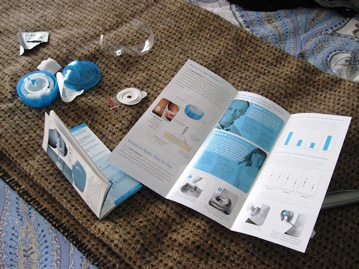
My messy diary along with box from i-port
The thing I loved about my six day experiment with the i-port (I was only given 2 samples - boo! hoo!) - is that instead of my having to do the human dart board practise on my stomach for my bolus shots 5-8 times a day - I just did my insulin injections through the port in my skin.  It really is like an infusion set that we use with an insulin pump - except it has no tubing - or connections to a little machine that goes ping.   The port is changed EVERY 3 days - which is the recommendation for most infusion sets.  Usually in the past, I've had issues with the teflon coated plastic cannula that remains in my body for that length of time.  Luckily, with the i-port I had no such issues, removing the port left barely a mark in my skin. 

The good thing about the i-port - less expensive then the alternative of an insulin pump (I can purchase the i-ports at Diabetes Express for $149.99 CAD for a box of 10).  This is bit less expensive then what I was paying for my infusion sets with my insulin pump - but the even bigger saving for me?  I'm not having to pay for a pump which ranges from $5-7K depending on where you live - along with the other supplies that go along with the pump (insulin cartridges, batteries, replacement caps, etc.). 

i-port put in place (really easy)
One thing I did find was that I didn't cringe at having to give another shot of rapid insulin for a little sinful snack or a correction shot.  It reminded me so much of the insulin pump I used to use - where a simple touch of the key pad - squirted insulin into my body via the infusion set - except with the i-port - you are the brains behind what insulin you are injecting with.

I have submitted a predetermination form thru' my husbands workplace insurance in the hopes that these ports will be covered - hopefully at 100%.  So wish me luck - since I'm really REALLY missing my little i-port right now - I felt very spoiled using the two I was sent. It's almost how I felt when I first disconnected from my pump - and went back onto multiple daily injection (MDI).  After almost a month of learning how to stay in the BG zone with MDI - I can now say - that ANYONE can do it - if they put their mind to it - and now I'm not missing my pump as I go into my 4th month of being pump free.


It stands out about 1/2" or abit less

My conclusion?  For anyone without insurance coverage - dislikes injecting to the point of not wanting to inject (not good - tisk - tisk - who hasn't done that in their life time with diabetes?) - I really think this is the route to go - to keep a diabetic from suffering the effects of poorly controlled diabetes.  


NB:  The i-port Advance has regulatory clearance in Canada, US and the European Union.  In the EU they currently have distributors in Germany, Italy and the Nordic Region and are in conversations to add some additional countries in the near future. India and Australia will be further down the road.


Sunday, March 24, 2013

Tori Davidson - Insulin Pumping since 1978


This blog was originally posted at Diabetes1.org back on January 24, 2012 - but I thought I'd share this with you here - since I think this is too good a story - about someone who has been pumping close to 40 years.

-------------------------------------------------------------------------------------------- 

Here I am, coming up to my 4 year anniversary of using an insulin pump (and wondering what to do after the pump warranty expires - that's a blog in the making - as I figure out my alternatives that Animas has been throwing at me - which seems to vary from one individual of the company to another for some strange reason).

My last blog post about infusion sites pulling out created some interesting comments on my Facebook page - The Roller Coaster Ride of Diabetes as well as my personal page there.  I heard from many insulin pump users saying of how many times they'd yanked there infusion sets out - and I honestly think I've been blessed with a horse shoe up my ass that it's only happened maybe a few times.

One gal, Tori Davidson from Brisbane, Australia wrote to me and told me her story about the early years of insulin pumping back in 1978.  She was barely a teenager, having problems with control of her diabetes, and became one of 10 people (aka guinea pigs as Tori and I like to call ourselves with what we've used over the years) to partake in the use of an insulin pump (which we're not like what we use today - we've come a long way).

Below are Tori's words, which she has graciously allowed me to share with you.  I think it's amazing what she went through, and not sure if I could have gone through it.  Funny enough, I didn't know about insulin pumps back then, and neither my parents or medical team had ever mentioned insulin pumps.  In away, I wonder if they were with holding that info from me - who knows?  Read on - you won't be disappointed by Tori's story ....


" I was thinking at some ungodly hour some years ago how much I love the current pumps, and how different they are from 34 yrs ago, and thought I'd actually specify what pumping in 1978 involved.

First off, there were no easy plastic cannulas you inserted at home. Initially, the cannulas were similar to IV drip cannulas, and yes, they hurt. Mine were inserted into my butt... but not just put in and left, no no. The whole procedure was done at the hospital and involved betadine swabbing, a local anaesthetic, at least two medical staff, the whole shebang/catastrophe. After the site was swabbed thoroughly and the local given (why do locals sting so much??), the doctor (usually an endocrinological registrar; if you were unlucky, a resident) would thread the cannula in, using a rather large introducing needle (21g I think), then back OUT, and in again. I have no idea why this was necessary, but at the time it was deemed to be so. If these sites had problems - infections - they exploded along the whole line. I had one infection so severe that 25years later I still have a small crater on my right buttock from it being excised and drained (but thankfully can no longer remember the intense pain associated with the three direct penicillin injections straight into the site that were administered). Sites were usually replaced every 5 days, and I dreaded those days. The whole procedure took about 3 hours.

As a back up, we had "butterflies" (winged infusion sets). If a cannula came out, a butterfly could be used as a stopgap until a new cannula could be inserted. Butterflies brought their own horrors, of course. While they had a much finer gauge (as small as 25G at one stage, more commonly 23G) and were far shorter, positioning them was very difficult because they were inflexible metal needles. Regardless, the trauma of the cannula insertions led me after 3 months to request the use of butterflies on a permanent basis (at the ripe old age of 13!).

Now, one problem with the butterflies was that the tubing actually absorbed insulin, so priming them was a time consuming business. First, insulin for the "day strength" syringe (presuming it was day time) had to be prepared (I generally prepared 6 days' worth of day and night syringes in advance, and labelled them so I could tell them apart, storing them in the fridge). Preparing a syringe was fiddly/fussy, but not difficult. It meant getting a 2ml syringe (or more, depending how many were being prepared), using an insulin syringe to withdraw the correct amount of insulin for the particular syringe, injecting it from the drawing up (insulin) syringe to the "pump" (2ml) syringe, then using a second 2ml syringe to add normal saline to the pump syringe to dilute the insulin adequately. The fully prepared syringe - with insulin and saline in proper proportions - could then be capped with a sterile needle and stored in the fridge. Day and night strength syringes were quite different, and varied over time. To actually prepare the butterfly meant taking the pre-prepared syringe, and rinsing the tubing of the butterfly out TWICE, before gearing it up for insertion (we also did that with the 2ml syringes, adding a small amount of insulin and flushing it through the syringe twice).

Using butterflies was "interesting". When I first started putting them in, an insertion, including swab padding and taping took me about 15 minutes. After some years I had it down to 2.5 minutes (yes, I timed it, I was a busy girl!!). Using both cannulas and butterflies meant you could only sleep on 3 of your possible 4 sides (front, back, left and right), as you invariably had a sore spot or a potentially sore spot on the fourth. If you bumped a butterfly it was wont to dislodge, which was not only extremely painful but meant, of course, that your insulin delivery was disturbed or possibly discontinued. I look back on all of this and wonder how I endured 17 years of it really - but endure it I did, and gladly. Finally I was able to eat what I wanted when I wanted and I was no longer left out of more "normal" activities that had previously been denied me because of my diabetes.

Placing a butterfly involved having the following things on hand: butterfly, syringe, pump, gauze pads, tape, and alcohol swab. First, the site had to be swabbed (in later years I left this part out, as well as the priming of the tubing). The butterfly was "fed" with insulin (no checking for air bubbles back then). Then, the needle would be inserted, at anywhere from 40-70 degrees. Gauze placed under the wings of the butterfly helped to prevent it pressing down and thus the actual needle pushing up through the subcutaneous tissue (ouchy!), meaning it stayed relatively stable; a piece of gauze over the wings meant that the entire dressing could be replaced at any time without (theoretically) displacing the needle. Lastly, tape would be applied liberally to strap it all down, and the syringe and pump would be reconnected.

The first pump, of course, was somewhat of an encumbrance. It was a Millhill infuser, and it was all metal. Hence, every time I flew to Sydney (my family and I were living in Canberra) it would set off the metal detector. Canberra airport in the mid to late 70s was a quiet place, however, and they came to expect me every 3 months, jetting off to Sydney for my 48 hour line to be put in, where blood was taken every 30 minutes night and day to try and get a profile of what my blood sugars were doing. It was all very false of course, but all they could get, since I refused to do even rudimentary tests at home (when they became available). The Millhill was about 20cm (8") long, 10cm (4") wide and 5cm (1.5") deep. It was LARGE. It was later replaced by the Graseby Infuser, which was slimmer, but still large. Both were kept (by me) in a specially made pouch that was worn on my thigh, with straps that went up around my neck (sans boobs) and my waist (apres boobs), with an additional - optional - strap around my thigh to ensure it didn't bounce around.

The pumps did not have variable basal rates. You had a set rate and that was it - but at least it meant you were getting a steady stream of insulin 24hrs/day (all being well). The number of times I disconnected and then lost my needle, dressing and all, in the surf is uncountable. I hate to think what the finders thought of their strange flotsam and jetsam. Bolusing was also an interesting event. In theory, you could program the pump to push through X mm (yes, millimetres, on a scale, which had to be converted depending on the size of the syringe - 2ml was my standard but these pumps could take 5 and 10ml syringes as well - to ml, which then had to take account of how much insulin - diluted, remember - was in each ml) at a particular time. It was very difficult, so much so that I took to just going "OK, here's my syringe, I know it has about 0.7units per .1ml, so I need half a little mark" and manually pushing that through. If you didn't know how to carb count, you were completely lost - and even some of us who knew how to do that - in "portions" - were still lost.

It's funny, I've just written all this and it sounds archaic and nightmarish now .. but at the time it was cutting edge and it saved my life. I still have my old pump and pouch. I wonder if I'll ever discard them? Somehow, I doubt it. "
Tori Davidson - pumping since 1978

Saturday, March 23, 2013

Is This The Final Chapter of the Johnson & Johnson Animas insulin pump conspiracy?


 I just finished up my walk on my treadmill - watching this week’s episode of  Glee (some great tunes in this "Guilty Pleasures" episode).  It got my brain whirling on a subject I’ve been trying to figure out how to write since my “chance” meet up with Mr. Paul Flynn, Director of International Business Development at the CWD FFL in Toronto a few weeks ago.  

I just happened to be checking out the PING, for curiosity sake, with one of the reps at the Animas booth.  I started to talk about my issue with the 2020, and in my overly imaginative mind, he swooped in, to pull me aside from the booth, and proceeded to talk to me.  No name tag like everyone else was wearing, but just a pleasant looking guy, who quickly said his name (I didn't catch it again until near the end of our conversation when I asked for his business card).   I then started my polite rant that I’ve been blogging about, writing to Animas Corporation/Canada about since Dec 2012 here at Diabetes1.org.  Deep in my mind, I wished I wasn’t alone in this convo with him, as all that I write here is hearsay, no video, no recording of our conversation, just my own words. 
In the beginning, Mr. Flynn appeared to not know my story, and I sensed something wasn't right with the way he was holding himself as he listened politey.  Then slowly, the truth started to come out when I mentioned Caroline Pavis who is the Director of Global Communications in the USA.  I'm not good with names sometimes, since I need a face to put to the name, and I stumbled abit with her name, and he corrected me.  That was when things started to change in how I approached my questioning to him.  I was determined to get to the root of some of the nagging answers I'd been given by Ms. Pavis over the last few months.   

Take a deep breath, smile ......

He told me that my approaching Animas Canada/Germany/NZ branches would yield me the same answer that I have received all along from Animas Corporation.  I am out of pump warranty zone, I will continue to be notified when the pump will stop functioning on such and such a date, so that I can purchase another pump from Animas Canada, end of story.  It's like he had was a recorder - turn on button - tape will play sort of thing - and quoted me verbally line per line the same statement I've seen online / email / recall notices. 

Take a deep breath, keep calm  .... 

I also inquired as to why the END DATE is not shown in any of the manuals that Animas pump holders are given.  Do they not have the right to know that the product they are purchasing has an end date?  If I'd known back in 2008, perhaps I would have gone with a pump that I knew would last longer.  He did not say anything that either confirmed or denied that Johnson & Johnson (J&J) were in error for not informing their clients.
   
When I had asked him about Fraser Gray, who after reading my original blog back in December, decided to approach Animas Canada about his own pump (we both had same warranty end date) – and that he DID receive a PING pump  in exchange for his 2020 - without any warranty mind you, why was he the exception? That when others like myself approach Animas Canada/Corporation, it’s been a flat refusal of no.  Mr. Flynn played very cool, and said he was not aware of Fraser.  Again, as we spoke, I reworded my questions again, and in actual fact “maybe” Mr. Flynn did acknowledge he knew of him in the end – but used the “must protect client confidentiality” line.  The glazed look in his eyes made that pretty clear – I’d not get anything more out of him.

One thing that I did discover in my conversation with him –the Animas PING has an END DATE as well – that it can only hold so much data  – like all  previous pumps before  – except that date is December 31, 2022 – so buyer BEWARE if you purchase a pump (2020) like I did in 2008 – it won’t last past more then 10 years if you are lucky when it's out of warranty. 

Remember to breath, stay calm, focus like you're a cat ....

I then questioned him as to why this had not been corrected (a few pump companies I have approached in my research do NOT have any END DATE).  
He could not answer that – aka – it’s not in his department  - understandable – but it would have been nice to have maybe been told someone from Animas Canada would get back to me on explaining why.  I do realise it costs to write up a program / change it / etc. – but at the expense of patients health?  Why do other pump manufacturers I’ve talked to over the past few months not have the same issue with their pump software?  That basically was the end of the conversation - no more could be said - until I could get home and start digging deeper. 

Run to my friends table, break down, be petted and consoled ...


I once again went to my beau from high school, Harold Swaffield aka Swaff and a T1D who right from the start of my blogging about Animas pumps, has been by my side with technical advise.  He can’t really say for sure why their pumps are like this (he finds it mind boggling too) – as he’d have to pull the pump apart to figure it out it's inner workings (guess where George Michael is going to when he stops working - sorry George) - but still we've been going over some possible reasons.  Be warned, this bit that follows gets abit technical, so if you want to continue reading – maybe it’s something you should be aware of and question when considering purchasing a new pump - again - if this is the problem behind the pump shutting down completely on X date.

Swaff doesn’t understand what they are storing in the pump that needs to be constantly updated taking up space.  My DH and I had thought that they are perhaps using an  EEprom and not the Eprom (see definitions below) but the big difference is the PROGRAMMABLE part of the pump. Swaff has always used an MM pump that requires some things to be stored but all these devices do, except once the data is stored, it NEVER gets updated again, until he changes it, thus rewriting the EEPROM again.  Swaff was saying that this is protection so that you don’t lose the data on a power off. The EEPROM stores the data so that when power is reapplied, it just starts to work!

The other part of the puzzle is we don’t KNOW what they are STORING on the device. The less cheaper way would be to have an internal SSD (solid state drive) or something similar to your standard USB key. In his words … “ Honestly...  32GB of USB is like $22.00 retail. Probably more like $.40 wholesale or less! 

His guess, like mine and others, is that Animas are ensuring that we will NEED to purchase another device, which is, in his words (and my thoughts too)  “ sucky really, sort of like a virtual end of life ".   What really bugs both of us the most is that they continue to sell the devices up until the day before it expires. So, the individual, NEEDS to purchase the next revision of the device. I mean honestly, a medical device that costs the average user, $5000 - $7000 ….  Gee let’s keep the company going!  It probably costs these companies $300 to make them, add the R&D costs, and yes, you can add an additional $1000 or $2000?? (people, manufacturing time,  etc.)

You wanted to know what some of the above means?  Well, here's the definitions for you students today -

EEPROM (also written E2PROM and pronounced "e-e-prom," "double-e prom," "e-squared," or simply "e-prom") stands for ElectricallyErasable Programmable Read-Only Memory and is a type of non-volatile memory used in computers and other electronic devices to store small amounts of data that must be saved when power is removed, e.g., calibration tables or device configuration.
EPROM erasable programmable read only memory, is a type of memory chip that retains its data when its power supply is switched off. In other words, it is non-volatile. It is an array of floating-gate transistors individually programmed by an electronic device that supplies higher voltages than those normally used in digital circuits. Once programmed, an EPROM can be erased by exposing it to strong ultraviolet light source (such as from a mercury-vapor light). EPROMs are easily recognizable by the transparent fused quartz window in the top of the package, through which the silicon chip is visible, and which permits exposure to UV light during erasing.
Okay, are you still with me kids?  Hello, tap, tap, tap to the sponge brain …

In my words, J&J are looking out for the shareholders … not we the consumer who wants to own a product (pump in our case) that hopefully will last for many years.  The selling point of the Animas rep here in Montreal of J&J being such a family oriented place – is all crap IMHO.  They are like the many other companies, out to make share holders happy in their yields.  So what if their 250 subsidiary companies like Animas, Dupuy (hip replacement), Mentor (breast implants) – that people depend on? 

As far as pumps go, Animas knows that most people in North America and other parts of the “civilized” world usually have private/work insurance coverage or it is covered by the country they live in.  They know that most insurance companies will enable the pump users to have a NEW pump every 4-5 years.  They do not think of the individual that is perhaps not fortunate enough to have that coverage, which they pay out of pocket, for a product they hope to have for many years.  To admit that they have made a mistake in what I believe is false advertising of a product is shameful.  I could not work for any firm that would pull the wool over the clients eyes – and sad to know that insurance companies are not aware of this (or maybe they are – they are all in on it together – it makes money!!!).

I know that there is a small percentage of Animas 2020 users out there – you may feel the same way as I do with being duped.  Sadly, we are a small number compared to those that really don’t care, they have coverage, they will continue to have a new pump every 4-5 years - sigh.   If they  knew more about where their hard earned monies go – into health plans, etc. – maybe they would start questioning who they deal with.

Be careful who you deal with – PLEASE - ask as many questions as you can before signing the dotted line – PLEASE - it could affect your life!

Tuesday, March 12, 2013

I'm still feeling High!


Okay - I've maybe worded the title incorrectly here - but psst - did it get your attention or what?

My HIGH comes from the incredible weekend I just spent with T1D kids/adults, T3's (parents/grandparents/sisters/brothers/etc.) at the 4th annual Children With Diabetes (CWD) - Friend for Life (FFL) conference and expo in Toronto, Canada. I actually am feeling a little depressed about being away from "my family" - missing the sounds of the beep, beep, and whirl, whirl of various medical devices being used around me - that I use myself to stay healthy with my diabetes. It felt so amazing to be part of such a big group - that got each other - we didn't have to question why you were doing this and that - do it in secret like some diabetics I know that hide out in dirty washrooms to test their blood glucose (BG) or bolus with insulin. It was just so cool is all I can say!!!

The last time I attended in Toronto I was part of the staff - and because of that missed out on all the great conferences that are presented. This time though, I wasn't asked to help, and of course, I felt like having abit of a pity party (memories of Joe Solowiejczyk talk about dealing with diabetes are going thru' my head here - I cried so hard with laughter - "Yipee I love having diabetes ... NOT!!!").


This time I managed to get our god daughter, Catherine and her son, Aaron who is a T1D like myself to come along. I do not think they regret one bit about my dragging them along (well - their only regret is that they didn't take up my offer of ear plugs - since I still am not 100% well - and snored ... or should I say ... purred REALLY loud). 


Sock Monkey paying attention
Catherine met up with other D-parents like herself, exchanged contact info and I'm hoping they stay in touch for many years to come as their children grown up into adults. So, the 6 hour drive back home after such an exciting long w/e was abit of a drag, as we didn't want to say good bye to everyone, but with good tunes and a GPS (Toronto is a big city) - we got back home safe and sound. Aaron is now putting his plans in action to figure out how to raise monies to attend the CWD FFL 2013 meet up in Orlando, Florida this summer. Obviously, he didn't get enough in Toronto!!!

For myself, it was meeting up with all the parents (some actually were looking out for me with my ears since they follow my scribbles in the sandbox at Diabetes1.org and in other social media areas I post in). Listening to their fears of their children with diabetes and trying to reassure them that with great patience - their kids will do alright, just like I did with having family members that looked out for each other with living with this disease (I hate calling it that - since to me - it's not a disease - it's just a hiccup in my life - that I try to make the best of the situation). Also spending time with the kids, sharing laughs, dancing (okay - it was more like an aerobic workout for this old D-cat) - just AWESOME!

Sock Monkey wanting to get in on the action!
Sadly, this maybe the last FFL being held in Canada, due to sponsorship - sigh. I have to admit, I had hoped that there would be more pump manufacturers other then Animas (you know my reasons there - and forthcoming blog will be revealing abit of a shocking conversation I had with Paul Flynn, Director of International business Development of Animas Canada). Perhaps, if those other companies, and a few more that have products aimed at diabetics all pitched into the pot, then I'll be writing about the next Canadian one that I am able to attend.

If you are interested in checking out the presentations (I know I'm going back to go over some of the notes I took down) - you can find it all at this link


Tired but happy bunch on the road back home!