Showing posts with label #DOC. Show all posts

Saturday, May 21, 2022

Disappointment with the Ontario Government's Assistive Devices Program

Last Tuesday, I finally had my endo appointment.  While my A1c is at the highest it's ever been since I started insulin pumping, the team had no problem with it.  When you're used to being able to use a Continuous Glucose Monitoring device (CGM), it can be a great tool for waking up from an overnight low (especially if you live alone, or have a partner who doesn't wake up to anything).  Sadly, as most of us can attest to, many of us with Type 1 Diabetes (T1D) don't sleep very well (my Fit bit doesn't lie) - because we are tuned into our bodies as best as we can to detect lows/highs.  I fail at miserably without having a CGM to recognise those fluctuations in blood sugars that for some make make or break them.  

I've been hypo unaware all my life.  I didn't realise this until starting on an insulin pump in 2008, and learning about CGM's.  I'm very lucky that no ill effects have come from often working with being at times so low, I wondered how I did it.  I either must have a very strong will to not let diabetes effect my work, or now that I think about it  ... I was dumb and uneducated as to how low blood sugars can bugger up your brain.  Luckily, in 2014 I was gifted Dexcom G4 receiver/sensors, and my life changed at that time.   I've been fortunate to have had over the years friends with benefits that have helped to keep me supplied with their discards as they go onto more advanced systems.  A nurse onboard the cruise ship I was on a few weeks ago (still working on that blog - it's an interesting one) - who was from South Africa - explained that in her country many diabetics like myself are unable to afford these pieces of technology.  We both agreed, it's only the rich folks / countries (we laughed sadly at ... the white man privledge - especially in the developed countries).  

Since earlier this Spring, when the Ford government released the news that CGM's would be part of the Assistive Devices Program (ADP) in Ontario.  Except the catch was, only 29% of T1D's would be able to have coverage.  I'm not one of those 29% since even though I am hypo unaware, I do not fall into the other areas that would allow me to have some help with paying for this device.  As someone said, have a few bad hypos ... go to ER ... then you'll have proof that you need a CGM.  It's like, WTF, no way.  After having attempted suicide last year and ending up in ER where it took awhile to get my blood sugars stable, I'm not going to play Russian roulette with my health.  

I'm lucky I survived this, but to do it again to be able to prove that I need the CGM?  What goes through my head is, the cost of that ER visit, along with 3 weeks in the mental ward (where staff did not understand what T1D was, and the hospital records I have access too statingf that I'm not a well controlled diabetic).  Fork it!  Give me a realiable CGM (and correct insulin coverage) and I'll be able to show you what this tool can do to help a T1D, and not be forced to do ER visits for lows/highs.  The cost of these hospital trips far outweigh what the cost of being supplied the CGM by the province.

The one thing that has come to my mind since being denied coverage through ADP for the CGM based on the guidelines ..... 

DISCRIMINATION

Why do T1D's who are on Ontario Disability Support Program (ODSP) not have the same guidelines as we working stiffs for going on the CGM?   And when I say working stiff, many of us are either working 1 or 2 jobs to pay the bills, usually at minimum wage (currently in Ontario it's $15 CDN / $12.68 USD / $16.60 AUS / $11.06 EURO ).  Majority of work that many of us are able to find also do not have health benefits.  I would love to have all my medications, eyeware, dental to name just a few covered, even if I wasn't fully reimbursed ( here's what is covered through ODSP ). Yes, I know I will get comments, stating how little ODSP recepients receive from the Ontario government, but either they don't understand how much health benefits are if they were paying for it on top of their rent/food/entertainment monies received.  I could go on here, but as someone who has always had to budget in order to afford things, I've given up luxuries that I'd love to have just to be  able to live.  Is there something wrong with me???  That I give up not having a dog, a new car, a pack of menthol ciggies (yes, I used to smoke occassionally but a $20/pack ... that's potential food on the table or a credit card bill), a coffee out more often? 

So, with that in mind, I'm going to attempt to reapply for the Disability Tax Credit, that I'd been fortunate to have that helps pay off medical expenses that aren't covered by province.  I did finally find an endo willing to sign it off last year, but even with following guidelines from various virtual diabetic events I've attended in .  I was deemed to not be "meet the eligibility criteria".  And yes, this lead up to my suicide attempt last summer, because I felt so unsure as to why I had been accepted prior.  Why do government institutions make it so hard for the honest person to be able to have some financial help and be a productive part of society?

Tuesday, December 8, 2020

Doing the limbo dance with carb guessing


On the weekend I was attending the 3-day Friends For Life Winter 2020 virtual conference.  Even though it’s aimed at parents of Type 1 diabetic children, it is an event that even grown up Type 1 diabetics like myself can attend.  You would think after all these years as a diabetic, I would know it all, but I don’t.  I learn from both young and old through organisations like this, in Facebook/Instagram posts/groups that keep me sane and alive at times, especially during this year of Covid-19, where events like this have now gone virtual.

One of the speaker sessions that I attended was by Constance Brown, RDN on Carbohydrate Controversies: How Low Should You Go?  I’ve always been curious about low carb eating, as many of my diabetic mates swear by better blood sugar control, etc.  For me, to go under 100 grams of carbs a day, isn’t something that I can do.  It takes a lot of dedication and sometimes depending on where you live, a more expensive option of eating for purchasing of keto ingredients .  The good thing is that Constance stated that whatever works best for you is all that counts, so don’t feel bad if you enjoy bread like I do! 

If you’re new to diabetes, you are maybe finding it daunting to figure out the carbs in your food, when figuring out the amount of insulin to cover the carbs you’re about to eat.  There’s so many things that we diabetics have to think about before even contemplating what’s about to go into our mouth, let alone figuring out what we’re going to make for our meal.  On top of all of this, taking our fast acting insulin at least 20 minutes prior to eating a meal that we can’t even maybe visualize yet on our plate before our eyes can be a daunting feat!  I mean, imagine just digging into your plate of food, not having to think about this number and that! 

So, to at least start off on the right foot, an app was mentioned at the talk that I’m going to be downloading called “Figwee Visual Food Diary” .  It has a library of foods (I think it's at least 8,000), that as you can see in the video at this LINK , if you just want “x amount” of apple slices, you pick the amount you are about to eat, and viola you have your carb count along with calories (great if you’re trying to lose Covid-19 weight like I am)!

As usual, portion control is the most important thing, along with the quality of the foods we are eating, and at this time of the year, if we can make it easier to control our blood sugars, I'll try anything that can help me attain good numbers!

Remember as well, with going low carb ...

To get fat-burning physiological changes, you need to keep your carbohydrate intake exceedingly low (only 20 to 50 grams per day). This is hard to achieve or maintain and runs the risk of limiting important nutrients, phytochemicals, and fiber in your diet. ( taken from https://www.health.harvard.edu/staying-healthy/the-smart-way-to-look-at-carbohydrates )

Monday, January 13, 2020

Brain function in Type 1 Diabetics

Wow, it's hard to believe that the last time I composed a blog was in the summer.  Life has been a roller coaster ride and surprisingly, it has very little to do with diabetes hiccups, but more coping with everyday life and trying to keep plodding away at work to pay the bills.  Aren't we all in the same boat, unless you've lucked in on a win fall!
Also, I've taken a bit of a step back from social media.  Facebook to be exact.  It's too time-consuming and it's not real life.  Real-life is what we do outside of these machines that go bing.  Though I have to admit, Instagram is my fav social media hang out, as it has some great Type 1 diabetics who post not just about diabetes, but their lives outside of it.  It's a much happier place, and I guess I've always liked pictures. Of course, I time myself to how much I spend there!

One of my fav Instagram posters is Melissa Allison from Australia.  One of her children has Type 1 diabetes, and we just happened to click with our posts.  Her pictures are breathtaking showing their life in Australia as well.  You can follow her at ShinyBrightSkies .

Last week, she sent me an interesting study from Standford University that was released back in December 2019 on brain function being irregular in children with Type 1 diabetes wondering what I thought of it.

'  The study, published online Dec. 9 in PLOS Medicine, is the first to evaluate what happens in the brains of children with diabetes during a cognitive task. On functional magnetic resonance imaging scans, when their brains were at work, children with diabetes displayed a set of abnormal brain-activity patterns that have been seen in many other disorders, including a cognitive decline in aging, concussion, attention-deficit hyperactivity disorder, and multiple sclerosis. '

It's nothing really new to myself since insulin plays a big role in brain functionality and I've always known that another outcome of long term diabetes is possibility of dementia.   It's the reason why I try to educate folks with diabetes to keep their blood sugars from going too low or too high.  In my mind, our blood sugar when out of whack is like a car battery leaking acid onto metal.  Need I say more?

This wasn't new to Melissa as well, but she felt that this article was good ammunition when dealing with schools if a child was having problems in the classroom.  Showing that blood sugars can play a role in how our brain works.  I'll be passing this article onto a few of my school teacher mates, especially those who already have diabetics in their classroom, to give them a better understanding.

Another segment of the papers had me reread it a few times, and you'll understand why when you read it below :

'   The study found that, although the children with diabetes performed the task as accurately as those in the control group, their brains were behaving differently. In children with diabetes, the default-mode network, which is the brain’s “idle” system, was not shutting off during the task. To compensate for the abnormal activation of the default-mode network, the brain’s executive control networks, responsible for aspects of self-regulation and concentration, were working harder than normal in the children with diabetes.  '


The "idle" system not shutting off during a task really resonates with me, and I wonder is it because we are always having to think about whether or not we are low or high in the blood sugar area subconsciously in the background?  Other diabetics I've spoken to, have said the same thing, that our brains don't really take a rest, we are always thinking.  About the only time we get to go idle is sleeping.  That's if we aren't dealing with low or high blood sugar, whether or not we have the use of a CGM (continuous glucose monitor).  Our brains just do NOT shut down. 

As someone who been diagnosed well over 50 years, I wonder if that one of the reasons I had problems at school, it was a bloody challenge at times.  Of course my fav subject, writing/arts were my favs, but those don't gain your foot in the door all the time for employment!  I managed to grind through, but I wonder if I'd had the devices like we have today, that keep us more in check if perhaps I'd gone further on in education.


Saturday, January 19, 2019

Flying High While Chasing the Sun


   Earlier this month, I arrived back home to Canada after a 30 hour flight from Singapore.  I’d had a working / holiday  in Asia for the month of December that had started off in Tokyo, and couldn’t ask for a better holiday with the various countries we explored along the way while cruising  the high seas on the Diamond Princess (and discovering that some of what we take for granted as diabetics here with gadgets, etc.  is unheard of in many of the countries I visited - we are very spoiled!!).

   When I'd originally flown out earlier in December to Tokyo, I had worn my Animas Ping insulin pump after reading a comment on Facebook advising against wearing it when flying.  I've gone back to find that post since seeing it back in November before I departed , but you know Facebook, lots of action in these groups we belong to, and you need a lot of time/patience to search posts at time, and so far, I’ve had no luck.

   Fast forward to our rather turbulent flights at the end of the December to bring us back home.  Early 4 AM (ugh!) start to head to Changi Airport in Singapore (the most beautiful airport I've ever been and below is a little video at this link  I made with fishies in the Enchanted Garden). 


   The 6 hour flight to Tokyo I slept the majority of it, in-between my last bits of yummy food service on the flight.  Blood sugars were doing fine just like they had done throughout the whole month when I was on the Omnipod.  When we were approaching Narita Airport we heard the engines accelerated as the plane pulled up to a higher altitude to avoid either an ongoing plane (or a drone LOL?).  The plane landed and as usual we let all the folks in a rush get off with us being the last.  I noticed my water bottle that had been emptied earlier, sucked in pretty flat.  It’s not unusual for that to happen, but it was something that came to my mind later on when problems started to occur in the 2nd leg of our journey home. 

   Narita is a big airport, so with the 3 hour layover before our next flight, I got to use up the rest of our Yen walking around and getting some much needed leg stretching.  Of course, this kept  Sock Monkey amused as you can see below.  I’d noticed my Dexcom G4 that my trend arrow was straight but my blood sugars seemed to be rising with the alarm/vibrations going off.  No big concern to most of us, simple correction bolus, and all was good (or so I thought).  At this point in time, I still had a days’ worth of insulin left in the Pod, which I’d calculated would last out until the Pod needing changing when we got home to Canada.


   The next leg of our trip was  a 13 hour flight,  I realised something was up.  Corrections didn’t seem to be doing anything and trend line though still straight was showing blood sugars on the rise. Fiasp to the rescue though  I was worried about  the risk of stacking insulin at this point in and maybe going low fast.  The strange thing was that the Omnipod PDM at this point hadn’t alarmed of an Occlusion or possible problem with the Pod.  Confirming blood sugars with a meter to see if my CGM was off track, proved it was pretty well spot on.  I can’t say enough about how valuable a CGM is to a diabetic on insulin!!


25 mmol/l or 450 mg/dl

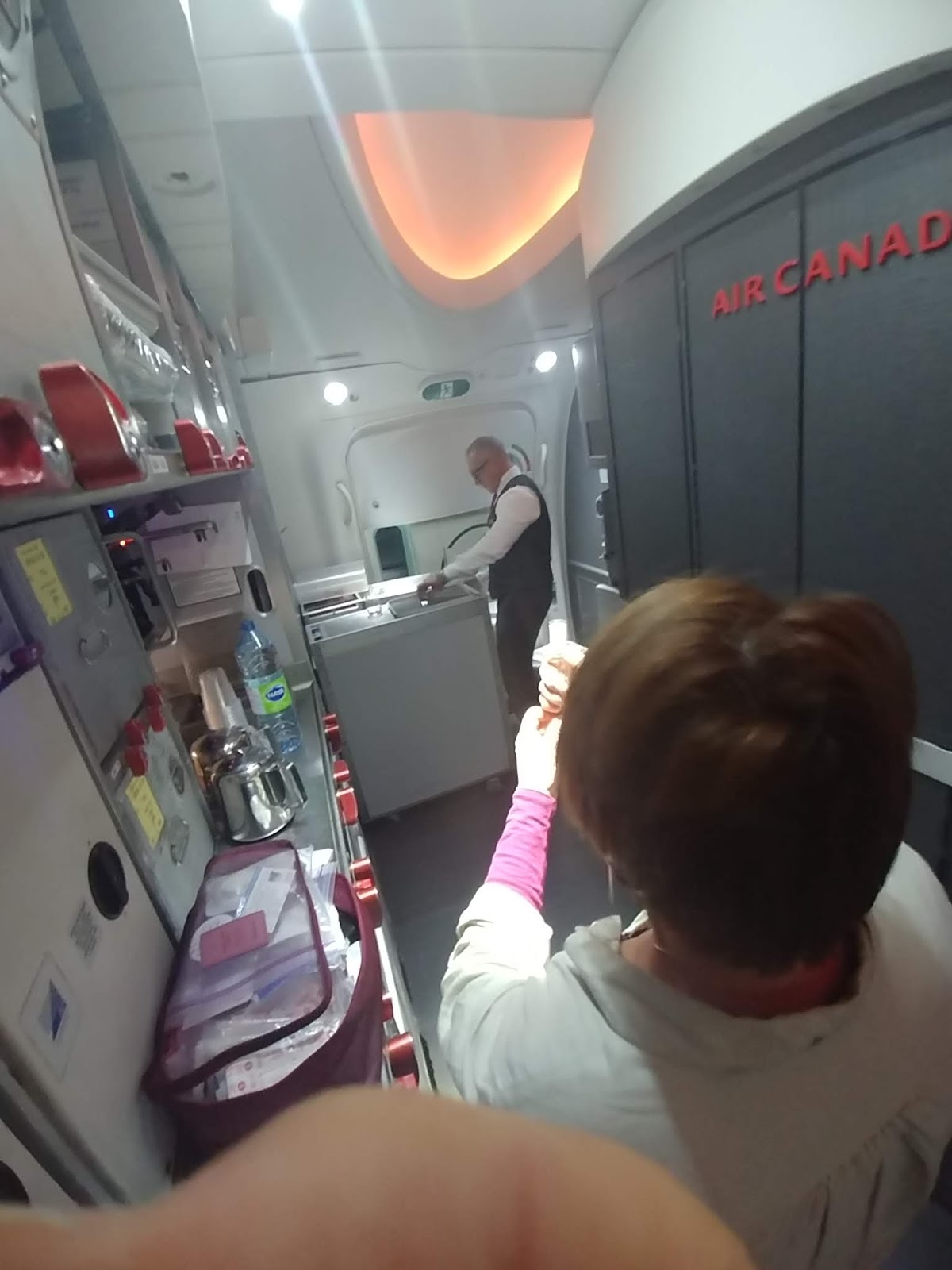
   We informed the Air Canada flight crew at this point in time that even with the turbulent air that we had most of the flight, that I was having some serious health issues and needed a safe space (not the cramped loo) to do some medical change outs and also to be prepared in case I crashed low .  Due to majority of folks on this long journey sleeping, with our mini flash light in our mouths, we pulled out my medical kit bag and proceeded to remove the Pod which when we looked at the site, it seemed dry as a bone.  This is unusual as usually you see either a drop of insulin and/or blood at the site where cannula is inserted and/or on the cannula.  Also, the cannula of the Pod wasn’t kinked, so obviously that wasn’t the problem.  My hubby Mike assisted me especially with the turbulent flight, and in less than 20 minutes, the Animas Ping was back up and running! Let’s just say the crew of Air Canada was very sweet in allowing me to take over a busy area and at the same time, they learned abit about insulin pumping and Type 1 diabetes.  Yuppers, that’s me, always the educator!


Back on my juice of life with the Animas Ping
   The waiting game started, and with the Fiasp in me, basal insulin working, within 3 hours, I was seeing my trend line going back to my happy zone that I like to keep myself.  I managed to nod off at that point (I was freaking out of course with what was happening earlier), but still being on high alert, it was a pretty crappy sleep even sitting in the Premium Economy that we managed to snag for a few extra bucks for this long flight home (personally, it’s not worth it, but we gave it a try, I prefer cattle class).

  Our conclusion of what we think may have happened - remember that water bottle above?  I found out from a long time Omnipod user that the reservoir that holds the insulin is a bladder, so unlike my Animas cartridge that is solid plastic, this one is flexible.  That could explain perhaps why the insulin was not being infused into the skin if the bladder had sucked itself in.  I had looked over the manual while on flight, to see if there was any mention of this, but there’s nothing stating that this could be a potential hazard.  I’ve talked to a few other Omnipod users, who do frequent long distance flying, it’s never occurred to them. So I’m a freak of nature.

   I dutifully reported what happened to Omnipod Canada (my first time calling Customer Service, and despite what Americans have said about them, which isn’t the greatest, I had absolutely no issues).  I did tell them that I was surprised that in the manual that there is no mention of this potential problem.  Having this at least mentioned as a potential problem would be a good thing to have in the manual, just in case.  The fact that not all insulin pumpers have the ability to afford a CGM that does keep you aware (if you have alarms set properly, etc. etc.) then it could be a potential problem.

   Meanwhile, to be on the safe side, I’ve reported this incidence to FDA and am still trying to figure out how to report it to Health Canada (it’s like looking for a needle in the haystack to find the area unlike the FDA that is very user friendly).  

   Yes, I’m still enjoying using the Omnipod, don’t get me wrong, but at least I’m now aware of a potential problem and will be more prepared, or wearing a tube pump,  and/or MDI to ensure I stay in my happy zone of blood sugar control when I'm flying or experiencing frequent air pressure changes!  Flying should be stress free!!!


Thursday, February 22, 2018

Where to start?


I am typing this out with one eye that is presently seeing 20/20 while the other I see nothing through my centre vision, it’s a hazy veil, and my peripheral vision, is webs of blood, etc.  

Once again, cataract surgery that I had last summer has reared its ugly head.  It is most likely due to the 2nd surgery done last October, to correct a problem in one of the lenses that the ophthalmologist had not been able to insert properly in the beginning (previous blogs explain it all).  Monday comes around (Family Day here in Ontario where everything is closed), with less than a week before seeing him, for follow up, I started to see a lot of floaters, which are blood bits which originally I thought were tiny flies due to a new rose plant I’d been given for Valentine's Day.  Along with these dots, webs, flashes of light in the peripheral vision of that eye ... I thought "fruitcake" what's happening now (if I could turn back time is playing through my head alot over these past 6 months).


Of course, things go through your noggin as you search Dr. Google.  Is it retinopathy finally rearing it’s ugly head after 50+ years of having Type 1 diabetes?  Am I having a stroke (my Mum, had one back in December that caused her to lose her eyesight in one eye)?  Am I developing perhaps a 3rd eye?

Joking aside, after making a call to see my ophthalmologist here, I’ve found what I figured it was via Dr. Google.  Posterior Vitreous Detachment or PVD. It’s common as we age, doesn’t cause blindness, yadda, yadda, yadda.  The 2nd cataract surgery, where I felt very uncomfortable to the point of puking, which I didn’t get with the original surgery, was due to the surgeon giving the eyeball a good workout as he placed the another lens into the eye.  My personal opinion, not that the surgeon will probably admit it, is that 2nd surgery most likely put a lot of strain on the vitreous which surrounds your eyeball.  You can read more about it if you wish from the link above that explains it all very well.

“ PVD itself is not a sign of a disease or eye health problem “

I like that above statement, since I am now looking out of one good eye, and trying my best to wait for the blobs, haziness to disappear, which they say can take up to 6 months and sometimes longer.  I am trying to make myself feel better by saying that at least the retina hasn’t detached, things could be worse.  The things we folks do with various health problems say to ourselves to stay sane.  What me sane???

Again, as my previous blogs have stated with my saga of cataract surgery … 

DO NOT HAVE IT DONE IF IT IS NOT NECESSARY!! 

Also, don't have both eyes done at the same time as a precaution against possible problems.  I would not have to be dealing with this if I’d just listened to my inner gut saying not to do it and my Mum too.


Rosina Kiff - 1935 - 2018 and me, Ann(a) Kiff >^,,<

Wednesday, November 29, 2017

Cranky one eyed cat

Yuppers, that's been me pretty well since my cataract surgery (see the original post HERE) - that has left one eye slightly buggered up for seeing properly. 

I am hoping I am doing the right thing here, since tomorrow, I am going back under the knife - to remove the original lens ... and have a new one put in place (with or without stitches - it all depends according to my surgeon Dr. Tarkek Youssef ... and yes ... I'm bloody scared!!! 


Like all of us with diabetes, our fear is always having diabetic complications with our eyes.  So far, touch wood, I've been blessed, but since the surgery back in July, it's been non stop problems that have left me drained emotionally, since I depend highly on my eyesight for the work I do.  I have finally, after 4 months, learned to accept my limited vision which varies daily, but it's put a lot of stress on everyone around me, since I can get a wee bit impatient sometimes!

I think my biggest fear tomorrow is ... the surgeon is performing surgery at the local hospital here in Cornwall rather than in his office (where my original surgery was done privately).  In the past (see my post of how my blood sugars over a 6 hour surgery caused DKA HERE), staff do not have much knowledge of Type 1 diabetics or the devices we use to stay healthy and out of overcrowded ER's!  It'll be interesting to see how things go with my wearing the Omnipod, and whether the PDM device also will be allowed in the OR ... along with the Dexcom CGMS.  If I was able to have my DH in the OR, or someone who has knowledge of what to do incase of alarms ... I would be more at ease. 

So, hopefully the next time you see a blog post or post on Facebook ...  I'll be more perky ... and I'll be able to perform my job that has been sadly sacrificed due to limited vision (my work requires good eyesight).  Though if I have to only have vision in one eye - I'm sure I'd be rocking a eyepatch that is out of sight!

Handmade eye patch from https://www.etsy.com/ca/shop/iPatching


Monday, October 2, 2017

I've Got My Eyes On You

Before I go on ... all I can say is #prayersforlasvegas ... words cannot describe my feelings of what happened in Las Vegas Sunday night. 


Last Friday night, one of my neighbours commented that my inner eyeball looked red.  It felt abit hot and itchy (I'm still not sure if I maybe had scratched it earlier, but since being told women are the worst out of the sexes to have eye irritations due to rubbing their eyes, I now am vigilant to NOT rub) .  If you think this is all poppy cock ... go check out this link to learn how dangerous it can be!

When I was washing my face later at night as I prepared for zzzzz time I saw how the blood vessels had broken in the corner of my eye.  Pretty ugly to say the least, but it was when I opened my eye up wide, I discovered what looked like a clump of cottage cheese.  Of course, I freaked out, when after washing my hands carefully, I couldn't dislodge it.  When my DH eventually heard me, he tried with a Q-tip.  No luck.  So, off to ER at Cornwall Community Hospital (CCH) we went.

Three hours later ... it was mutually decided to not remove it (the on call doctor said he could but to me that's like having a dentist do plastic surgery).  My ophthalmologist luckily was on call that weekend so he would be contacted the next day.  Main thing, they determined it was nothing serious and to use lubricating drops every hour.  I felt abit stupid going to ER, but they've told me that I did the right thing, especially being a Type 1 diabetic.  The fear of losing my our sight is always in the back of our minds, or it is for me!

So fast forward to Monday, which is today.  Took a cool stroll into downtown, and discovered that what the white clump is all to do with is the "Dropless/No Drops Long Acting Meds" that you see in the bill below when I had double cataract surgery performed at the end of July.  It will dissolve in time, and as the surgeon said, it lasts a long time.  I went this route rather than drops due to already having enough to remember about with diabetes and other meds I take.  This way, bing ... it's done ... though as he explained ... he thinks he should now maybe warn his patients about what may occur.

If you notice below, in the bill ... I went private due to feeling unsure about how I'd be treated at the CCH as a Type 1 diabetic wearing an insulin pump and CGM.  Also, any laser correction required for follow up to lens implant, is covered with this charge (this is where I'm abit puzzled, if I'd gone public, then I'd be paying for this???).  Laser has been performed once to remove cloudiness on the implanted lenses, called posterior capsule opacification (PCO) and is often more common in younger cataract patients - so that must mean I'm not an old fart <lol>.  Laser will probably be performed again to hopefully correct my other eye that surgeon had difficulty placing lens into the vitreous so it's sitting more securely (that eye had the bigger cataract .. my buggered up eye in this blog had just a itsy bitsy one starting).  Today, he also talked of removing that lens and suturing a new one in place rather than compromising my thinning vitreous.  The things I learned today when he was open and honest with both myself and my husband.


From a personal point of view, which is why I haven't written in awhile ... I wish I had never had the cataract surgery and saved the $3K for something else (wine, holiday, yadda, yadda).  I also wish I had not gone with having BOTH eyes done.  I only had a small cataract starting in the other eye (the eye that you see here in this post) ... the other one was supposedly larger.  I miss my glasses (have been wearing them since Grade 5), and during this process of recovery, miss having good vision.  My vision was never that bad even with needing extra light once in awhile due to the larger cataract, plus I only wore glasses for driving since my eyesight had been improving over the years believe it or not.  Now, both distance and close up ... are buggered up - I have my good days of seeing semi-clear ... and bad days where I frustrate myself and my husband to no end when I'm trying to read a recipe or magazine (I do not read as much or watch TV now that often - which I miss so much).  Again, I keep on telling myself it's still early days as other cataract patients (thanks Dad) have told me as well as my surgeon.
The only thing I can leave you with, if you are like myself, having doubts about going for cataract surgery along with the promise from your ophthalmologist of having perfect vision (which most times does happen ... along with not wearing glasses if you dislike wearing them).  DO YOUR RESEARCH ... this is coming from someone who researches diligently when creating a blog like this and didn't for her own health. I sadly, did not, and only saw afterwards a statement at the RNIB (see below) that if your vision is NOT helped by changing your lenses, then having cataract surgery is probably your best option.

If you need more help in understanding about cataracts, I highly recommend the Royal Institute of Blind People based in the UK ... it has amazing information ... written in easy to understand terms ... you can find a downloadable .pdf file at this website link.  If you're wondering about complications like I've just had with this surgery, check out All About Vision at this website link.


NB: the wait time for cataract surgery varies from province to province in Canada.  I was told if I'd not gone private that it would not be performed until 6 months later.  If you're Canadian and reading this, you maybe able to find a similar link like this one for Ontario wait times. 

Update to blog 2023-10-21  - with another link  below to a post that was written a few months later - when surgeon removed lens that they'd had problems with - and my fear of hospitals that don't understand Type 1 Diabetic patients - entitled Cranky One Eyed Cat . 

Sunday, February 26, 2017

Vampire testing on the fingertips


Okay, kidding aside ... as diabetics ... testing your blood sugar on your finger tips can be abit of a drag at times.  I've been doing this process since home testing was introduced back in the 1980's  (you can read more about the history of these blood sucking devices at David Mendosa's link HERE).  Even with wearing a CGMS (aka Bowie) which many people think means you won't have to do the old finger prick anymore, I still test on average about 6X a day, sometimes more, depending on what is going on in my life.

Recently, a family member of mine was diagnosed with Type 2 diabetes.  Luckily, with the help of their spouse, they're are diligently performing 4 tests a day in order to stay in a good blood sugar range to avoid any complications of high blood sugars.  The one thing they admitted to me the other day, was how much it hurt.  I discovered the "nurse" was pricking the fatty portion of the finger tip, where numerous nerves exist ... that beg <NOT> to be heard when they're mistreated.

Screaming Hands by http://lintza.deviantart.com/

I then slowly explained the best way to avoid the pain, by testing on their finger tips, which over the years I've shown nurses how to perform this task on their patients hands.  What better person to show them how to treat their patients, and not have them stop testing when they go back home to deal with diabetes on their own.

I even went as far as to post a few pictures on my Instagram account that you see below, since sometimes pictures are worth a thousand words!   If you've never tried testing on the sides of your finger tips, then give it a go next time, and be rewarded with no pain or scars.

Here's some of my tips to get the best results out of a pain free blood test:

  • Always wash your hands before testing, simple soap and water are fine (alcohol dries out the skin).
  • If your fingertips are cold, rub them gently to warm them up and get better blood circulation.
  • Use your lancing device on the SIDE of your fingertip to get a drop of blood sufficient for test.
  • Then hold the edge of the test strip to the drop of blood and wait for results 😀 


Wednesday, July 13, 2016

I want you to have a great colonoscopy


On July 4th (no fireworks that day, sorry I'm Canadian) I finally got around to my 2nd colonoscopy (I have them done due to my Dad having colon cancer).  My previous one that was done back in Quebec was an easy process, with doing that usual day before clean out, liquid diet (yes, beer counts as it’s a clear liquid).  When it was done (I wasn't on the pump then just my "poor man's pump" ), I was hooked up to an IV with a slow drip of insulin, no sedation, and got to watch the whole show of my squeaky clean A-hole on a screen.  Easy peasy – though they wouldn’t give me a copy of the video to share with friends on the big screen as we all ate popcorn!  I remember being so hungry, that a greasy breakfast was a must for me, and I was able to resume back to work the next day.

When I’d left Quebec last summer, I was still waiting to be called up for my 2nd colonoscopy which already was going into year 3.  Ontario seems to be alot better with wait times as I was referred  after going to a local walk-in clinic.  Night and day over Quebec health care system where the waiting game can go on for years.


This time, totally different, starting with the prep the day before.  It was a day of not being  actually able to work, despite sitting on my behind for the majority of one of my jobs I do.  Perhaps due to being a wee bit younger last time, what I'd used to "process" the goop out of me, who knows.  All I could do the day before was be a slug and I now understand why people don't like the prep bit - I feel for you all now.

The other difference this time, I was to be sedated aka " conscious sedation ".  I was told that I could not wear my insulin pump for this 10 minute procedure – but to give ½ my usual dose that AM (this was stated on the hospital form – obviously insulin pumps haven’t been updated onto the form).  I had planned on just giving a unit of rapid insulin in my pump, and then disengaging, but with some of the comments on my Facebook posts of how they'd kept them on during this procedure,  I convinced the RN that by lowering my basal rate of my pump by 50% things would all be good.  I decided at the last minute though, with my blood sugar showing 7.1 mmol/dl / 128 mg/dl – that I’d leave it be, and not reduce the basal.

I didn’t tell them this …

After a weigh in, that I insisted on them doing since they asked me what my weight was, and I told them I really didn’t know  (they wanted me to guess … it’s like … WTF?).  I found I'd lost 15 pounds (maybe the previous day of fasting helped shed some?) - and now I understand why my pants keep on falling down.  I figured the amount of sedation would be based on my weight (I have later found out since, that there is a limit to how much they give a patient (Versed and Fentanyl were used on me). 

Then came the " let’s find a juicy vein ".  Two RN's tried to find one in my forearm (and they're commenting on how tough my skin is … hello … diabetic of ½ a century … we have tough skin). They give up despite my saying my hand is the best bet but the clock is ticking for the next patient to be processed and they're understaffed.

So, it’s wheel the patient, moi, into the OR.  Where the doctor takes over in the game of finding a vein in my hand, and even better, he uses a butterfly needle, which just glides into that juicy plump vein in my hand (I sound like a junkie don’t I? LOL).   Then its lights out, night night Pussy Cat … despite being told by RN that I would be awake during the procedure.  No watching the screen like  the classic 1960's movie The Fantastic Voyage  ... I'm out ... cold ... no seeing the bowels of the Earth.


I awoke, wondering WTF, ½ an hour had passed since being wheeled in, and I was being asked if I wanted any biscuits and water.  It’s like, yes please.  Sadly, within 5 minutes, I was trying to be polite about requesting a … fetch me a bucket Garcon … and just about hopped out of the bed to go searching.  At that point, after the hurl session or two,  the RN brought me my clothing and I wobbly got dressed, texted my DH to come and fetch me.  I'm still amazed how I  managed to get myself out the right door to where he picked me up, I was that out of it and wondered why no one was asking if I needed a wheel chair.  For the next 3 days that was how I was, the effects of the sedation making me feel like I was having a hangover from Hell going between hurling, coldness, nonstop sleeping, and eating was a chore, but wait … this isn’t the end of the story yet of my anal probe.

Are you wondering about the highlighted bit above “I didn’t tell them this …”?


Stay tuned for the 2nd part of this blog, and be ready to be as surprised as I was …

Psst,  remember, if you don't follow me on Blogger, maybe now's the time to get cracking ... so you can keep up with my occasional blogs that come forth from my sponge brain!!!  I always aim to make them both educational and entertaining!


Saturday, June 11, 2016

Barley can help lower 'bad' cholesterol according to a recent study

Did you know that the cholesterol-lowering effect of barley could be a benefit to your LDL and non-HDL cholesterol level which is found to be high in Type 2 diabetics? It also has 2x as much protein and 1/2 the amount of calories as oats.

So, after reading the article that was posted at CTV news what does this gal who loves to cook with barley from time to time do (see my blog post with a delicious gluten free recipe from Katie Zeller of Thyme of Cooking at this link ) ? Goes on the hunt for a breakfast cereal recipe that uses barley and is also gluten free (I was coming up with recipes that contained wheat - so instead plugged in "gluten free barley recipes").

So, feast your eyes on the one below that I found at Project Open Hand that was posted back in 2013 by Raymond Palko and get started yourself on exploring other options for cooking with barley and feel free to post any other ones you may find below in the comments section!!

Also, if you are wondering what some of the barley types are that you will see in the recipe links below - then scoot on over to this link - which helps explain the different types available.


Hulled barley is a hearty and nutritious grain that makes a wonderful breakfast. It’s high in fiber and may help lower cholesterol. Barley takes longer to cook than some other grains, but the following tips make it a convenient breakfast staple in your home.

HOW TO COOK BARLEY
Soak barley to decrease cooking time. Soak 1 cup of barley in 2 cups of water overnight in a covered container, in the refrigerator. Drain and rinse the barley before cooking. This will provide multiple servings, which can be stored in the refrigerator and quickly reheated over the next 3 days. (NOTE: These directions are for hulled barley. Pearled barley commonly found in the grocery store does not require pre-soaking.) Barley can be cooked in a pot on a stove or hot plate, in a slow cooker, or a pressure cooker. It cooks fastest in a pressure cooker, slowest on the stovetop.
  • Stove: Add 3 cups of water to the soaked barley. Over high heat, bring the barley and water to a boil. Cover, and reduce the heat to low. Allow the grain to simmer for 45 minutes.
  • Pressure cooker: Follow the above directions, but cook for only 15-20 minutes.
If you like your barley chewier, cook for less time. To make it creamier like porridge you will need to cook longer. Once it is a texture you prefer, drain off any remaining liquid.


DELICIOUS TOPPINGS FOR BARLEY
Now that your barley is cooked, add any combination of the following items for a delicious breakfast:
  • Milk or soy milk (note from FatCatAnna ... almond or cashew milk is what I'd use)
  • Fresh or frozen fruit
  • Raisins or other dried fruits (note from FatCatAnna WARNING will add more to carbs so be careful)
  • Protein trail mix
  • Peanut butter
  • Nuts
  • Yogurt
Yes, I had to put a cat picture somewhere in this blog !!
Other resources to get your barley fix? Just look below -
  • Bob's Red Mill Barley Flakes (the recipe post above uses whole barley) ... so check it out here - you'll also find recipes using the product.
  • GoBarley - an international site based in Canada - that has some great recipe ideas and the story behind barley.
  • Heart and Stroke Foundation - just search for barley recipes - and you'll find alot of mouth watering ones to try.
  • I couldn't resist posting this recipe - that is made with mango, coconut and bananas (the recipe states that the barley can be made ahead of time and eaten over 5 days ... which is what I already do with oatmeal that I soak in milk overnight).
  • Last but not least - not into a sweet breakfast meal with barley? Then check out this baked savoury one that has me licking my chops as I finish up this post .... you can find the recipe at this link .


Thursday, November 19, 2015

My first endo visit in over 30 years!

I had my first meeting with an endocrinologist who works with insulin pump patients last month.  In the past I’ve used either my GP or a doctor that works in the endocrine area of the health field, but does not hold the title after their name (just like me, at times I’m like a CDE, but in reality, I’m just someone with 50 years of experience with T1D).  None of my past care givers understood pump technology, so as I’ve mentioned in the past, I do my own tweaking, and had been doing fine until menopause hit me last year.

The last time I’d seen an endocrinologist was way back in the 80’s … and I rarely saw them due to being busy with life, and in those days, we didn’t have all the technology today, so in some ways, at least for me, diabetes was just something in my life that today now seems to encompass my every waking moment with machines that read your blood sugars (CGM), or control the amount of insulin that goes into your body (insulin pump), along with blood glucose (BG) meters, and different types of insulin. 


It was an interesting meet up with the, originally they were coming to where I live (an hour and a half drive for them), but then a week before I was told they would have their head contained in a screen (my words – not the CDE’s words) … think of Max Headroom if you are of my age group you will know.  So, with the CDE in the meeting … we got started on figuring out my control of my diabetes, that I’ve basically been doing by myself the past 30 years.

I’d downloaded all my pump/CGM/BG meter info to Diasend that morning from home, so while the endo asked me questions, the CDE punched numbers on her screen while listening.   The endo couldn’t quite understand why I wanted a lower A1c which puzzled me, as I thought she would encourage me to attain a better number.  Explaining how many of us want to avoid complications, etc. with keeping a lower A1c didn’t interest her.

Their main concern was the hypoglycemic (hypo) reactions I have been having at night lately that they saw with the Diasend report.  Which is understandable after learning from various conferences I’ve attended over the year, hypos are harder on a diabetic body then a hyperglycemic (hyper) – e.g. going up high.  Of course, it all depends on how high you go up, but to me, anything over 15 / 270 freaks me out and the methods I use to bring even higher ones down she did not approve of.  I’m also still very lucky, I wake up to hypos, CGM or not, and generally do not over treat them which is what many diabetics do which results in that crazy roller swing.  I’ve learned over the years, depending on the BG number, to go from 5-15 grams of fast acting carbs, wait 15 minutes, retest.   Helps to offset that crazy high in the morning when you wake up.

The endo asked me to set my CGM alarm during sleep time to 15 / 270 in order to have a solid sleep (as we all know – lack of sleep can affect our blood sugars not just our sanity in our work place the next day or relationship that for me is already compromised by menopausal mood swings!).   Of course, freak out, I did request permission from CDE a week later after tying to follow endo’s instructions so I am now able to correct anything over that number, “safety first” as the CDE told me.  They just want me to be more sparse about it and only anything over 10 / 180 – which I have been doing – but this is way against the way I’ve handled my diabetes over the years by myself.  They are hoping to see what happens with my BG without correction, does it go up and stay up, or does basal bring it down.

I started to realise around that point that I had an endo that sticks to the rules and no matter what I said (e.g. I asked her if I could go on metformin, which has been shown to help T1D teenagers in attaining more level blood sugars … and that a study was being done with adult T1D’s using the drug and showing great success).  No, unless I was using over 50 units of insulin a day, she would not consider it.  I felt like I had the door slammed in my face at that point.


 My promise to follow a snack plan (carb/protein) in the evening as the endo requested in order to avoid hypos overnight – nope - that didn't last long.  Though I have now gotten into soaking almonds in water, and having about a ¼ of a cup before bed time and BG’s seem to be great overnight.  I really don’t do snacks at night time, which is something I did as a kid at home when my parents followed the CDA/ADA meal plan.

So, overall, I am realizing that it is the CDE team that is the most knowledgeable in diabetes management.  I have yet to tell them that I’ve gone ahead with upping my basal (the high wake up blood sugars during some of my major hot flash periods that last longer since I had the hysterectomy a few months ago was too much for my control level of diabetes).

It’ll be interesting to see how things go for my next visit at the end of January.  I do have a friend in Ottawa (he is on the study with Metformin) who has told me his GP who follows his diabetes is taking on new patients.  It’s something to think about, and with how I’ve always taken care of my diabetes, where I only go to see a doctor when I need a new prescription or have blood work done to see how I’m doing … I may just go back to that routine. 

Main thing for me, it’s an interesting experience to have a CDE team after all these years of my time with diabetes and even better is that they understand much of today's technology unlike my former doctors and I don't quite feel alone in working in the coal mine of my diabetes control.

.